
Chemical hair procedures like smoothing, keratin, straightening, bleaching, and coloring can instantly transform your look. However, it is not uncommon to notice increased shedding or strand breakage shortly after leaving the salon chair. If your hairbrush is collecting more strands than usual, learning how to stop hair fall after chemical hair treatment procedures is essential to protecting your hair density and scalp health.
While some post-treatment shedding is temporary, proper care and targeted recovery techniques are vital to prevent long-term damage. In this comprehensive guide, our salon hair care experts explain why hair fall happens after chemical services and share proven, actionable steps to restore your strands to full strength.
Read More Blogs
Why Does Hair Fall Occur After Chemical Treatments?
To effectively stop hair fall after chemical hair treatment services, you must first understand what causes the weakness. Chemical processes alter the physical and structural makeup of your hair in two main ways:
- Disulfide Bond Breakdown: Services like permanent straightening and hair coloring break the natural disulfide bonds inside the hair shaft to re-shape or lighten the strands. If bonds are over-processed, hair becomes brittle and snaps easily—causing breakage (often mistaken for hair loss from the root).
- Scalp Sensitivity and Chemicals: High concentrations of developer, ammonia, or formaldehyde-releasing formulas can irritate the scalp hair follicles, leading to temporary chemical-induced telogen effluvium (root shedding).
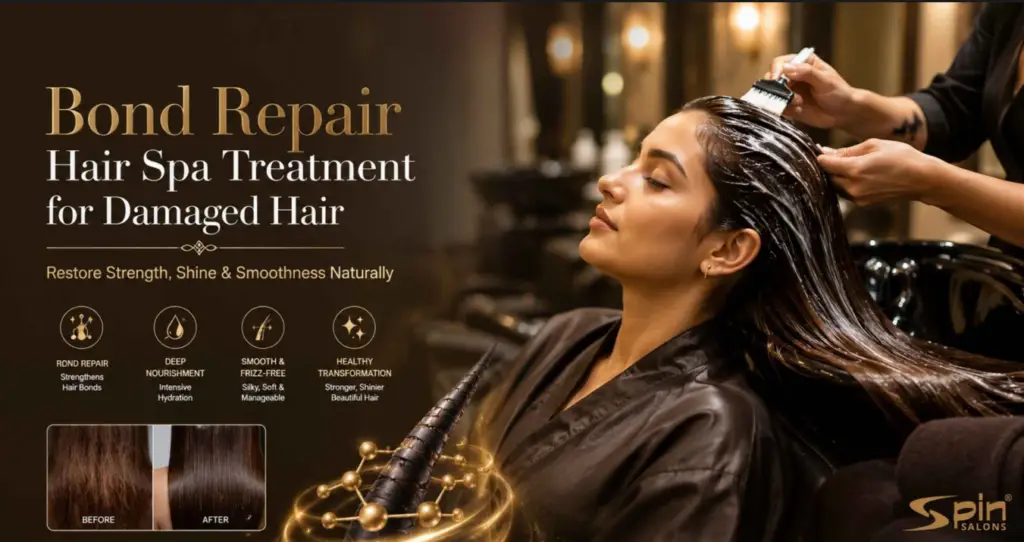
Bond repair treatment application for chemically treated hair. Source: Spin Salon
7 Proven Steps to Stop Hair Fall After Chemical Hair Treatment
Recovering hair density requires a delicate balance of bond repair, scalp care, and gentle daily habits. Follow these expert-approved steps to reverse damage.
1. Switch to Bond-Repairing and Protein Treatments
Chemical processing strips your hair of its structural keratin. To stop hair fall after chemical hair treatment sessions, introduce bond-repairing formulations (containing active ingredients like bis-aminopropyl diglycol dimaleate) and mild protein hair masks.
- How to use: Apply a deep-conditioning bond-repair mask once a week.
- Salon Caution: Avoid over-using hard protein treatments, as excessive protein without moisture can make chemically treated hair stiff and prone to snapping.
2. Ditch Sulfates for Mild, pH-Balanced Shampoos
Harsh sulfates (SLS/SLES) strip away the protective lipids that seal the hair cuticle. Always use a gentle, sulfate-free, and paraben-free shampoo specifically formulated for damaged or chemically processed hair.
| Recovery Phase | Recommended Action | Salon Expert Tip |
| Week 1 – 2 | Scalp soothing & gentle sulfate-free washing | Avoid tight hairstyles and hot water rinses completely. |
| Week 3 – 4 | Bond repair & intensive moisture masking | Introduce weekly hair bonding masks to restore elasticity. |
| Week 5 – 8 | Professional Hair Spa & trim maintenance | Get a salon trim to remove frayed split ends and stop breakage. |
3. Nourish and Soothe Your Scalp
If your hair fall stems from scalp irritation, keeping your scalp calm and hydrated is critical to help stop hair fall after chemical hair treatment side effects.
- Apply aloe vera gel or lightweight scalp serums enriched with peptides and tea tree oil to calm redness and itching.
- Avoid heavy oiling directly on a irritated, chemically exposed scalp for the first two weeks, as thick oils can clog sensitive pores.
4. Stop Heat Styling Completely for 4 Weeks
Your hair cuticles are extremely porous and fragile following chemical processing. Adding hot tools—such as straighteners, curling irons, or high-heat blow dryers—will accelerate breakage and defeat your recovery efforts.
Professional Salon Tip: Always allow your hair to air-dry up to $80%$, then use a blow dryer set strictly to the cool air setting if necessary.
       [ Chemical Processing Fragility ]
                      │
                      ▼
        [ Avoid Hot Tools for 4 Weeks ]
                      │
                      ▼
      [ Air-Dry + Cool Setting Blow-Dry ]
                      │
                      ▼
     [ Restored Elasticity & Reduced Shedding ]
5. Be Gentle When Detangling Wet Hair
Chemically treated hair stretches and breaks most easily when wet. To minimize mechanical breakage and help stop hair fall after chemical hair treatment:
- Never brush wet hair with a fine-tooth comb or standard paddle brush.
- Use a wide-tooth neem wood comb or a flexible detangling brush, starting from the ends and working your way up to the roots gently.
6. Get a Trimming Session at Your Salon
Breakage travels up the hair shaft like a split seam. If you do not trim damaged, split ends after a chemical treatment, the hair will continue to snap higher up the shaft, creating the illusion that your hair is not growing.
Schedule a micro-trim (removing just $frac{1}{2}$ inch) 2 to 3 weeks after your chemical service to seal the ends.
7. Support Hair Strength from Within
Topical products repair the exterior hair shaft, but internal nutrition supports new follicle growth. Strengthen your hair structure by consuming:
- Biotin and Amino Acids: Essential building blocks for keratin production.
- Omega-3 Fatty Acids: Reduces scalp inflammation and promotes hydration.
- Iron and Zinc: Prevents follicle weakening and excessive shedding.
When Should You Visit a Salon Professional?
While mild shedding post-treatment is normal, severe hair loss requires professional attention. Visit a salon specialist or trichologist if you experience:
- Persistent scalp burning, redness, or severe flaking.
- Hair snapping off in large clumps near the root area.
- No reduction in hair fall after 4 weeks of dedicated home care.
Our salon offers specialized restorative treatments—including Hair Botox, Scalp Detox Spas, and Concentrated Micro-Bond Therapy—specifically engineered to revive damaged hair fibers and stop hair fall after chemical hair treatment procedures safely.
This Content from chatGPT.com